Engineer and founder
6 years as co-founder and CTO
Tymeslot and In A Nutshell, built with agents
We can't find the internet
Attempting to reconnect
Something went wrong!
Hang in there while we get back on track
Ship twice as much. Keep the headcount.
Feedback from the teams I have worked with.
We had a Cursor AI training with Luka. He is a highly competent trainer who answered all our questions thoroughly and adapted the course to our needs and preferences. I highly recommend working with him!

Herbert Reiter
Chief Technology Officer (CTO)

Agents take six kinds of work off every engineer's week, and the freed hours go into shipping.
Illustration: in an engineer's week with agents, the six kinds of work below take up far less of the week, and the time freed up goes into shipping more.
Same headcount. More shipped every week.
Hands-on, on your own codebase. Further topics on request.
Hand over a whole ticket, not a prompt, and keep several agents running at once.
Repeats until the tests pass
Agents with your team's context
Several agents, one engineer reviewing
Guardrails that hold as output rises
From a few enthusiasts to the whole team
Briefing leadership too? AI training for leadership teams
Booked by a company for one engineering team, run on its own codebase.
A good fit
Not a fit
Ten quick questions on setup, adoption, integration and results. You get a score for each and the engineering training that fits where your team stands.
Each course has its own curriculum, prerequisites and lengths, and every booking is adapted to your stack. Pick your team's tool, or start with the fundamentals.
Drive Claude Code through real feature work: steering it with project instructions, keeping diffs reviewable, and setting guardrails that hold up in a production codebase.
Get a team genuinely fluent in Cursor: which mode to reach for, how to teach it your conventions, and how to keep a twelve-file change reviewable.
Move a team past tab completion into Copilot's chat, edit and agent surfaces, its role in code review, and the enterprise controls around all of it.
Hand engineering work over to Codex and get it back finished: task briefs, parallel runs, environment setup, and reviewing a change nobody watched being written.
Decide how your organisation codes with AI: comparing the tools honestly, agreeing the practices that transfer between them, and running a rollout that produces evidence.
Build agents that survive production: tool design, orchestration, evaluation, and the guardrails that decide what happens when one goes wrong.
Build a working MCP server against your own systems, from the protocol up to auth and distribution.
Run language models on your own infrastructure: choosing a model, sizing the hardware, serving it to a whole team, and keeping the data inside the building.
Engineers listen to someone who ships code. Habits change with someone who knows why they formed.

6 years as co-founder and CTO
Tymeslot and In A Nutshell, built with agents
Top 2% in a master's in management
BSc Psychology
Three steps. The first is a free call.
01
Thirty minutes on your stack and how much agents can take on.
02
Rebuilt around your repositories and real tickets from your backlog.
03
On site or remote. The team leaves with agents doing real work.
Articles from the blog on the topics behind this service
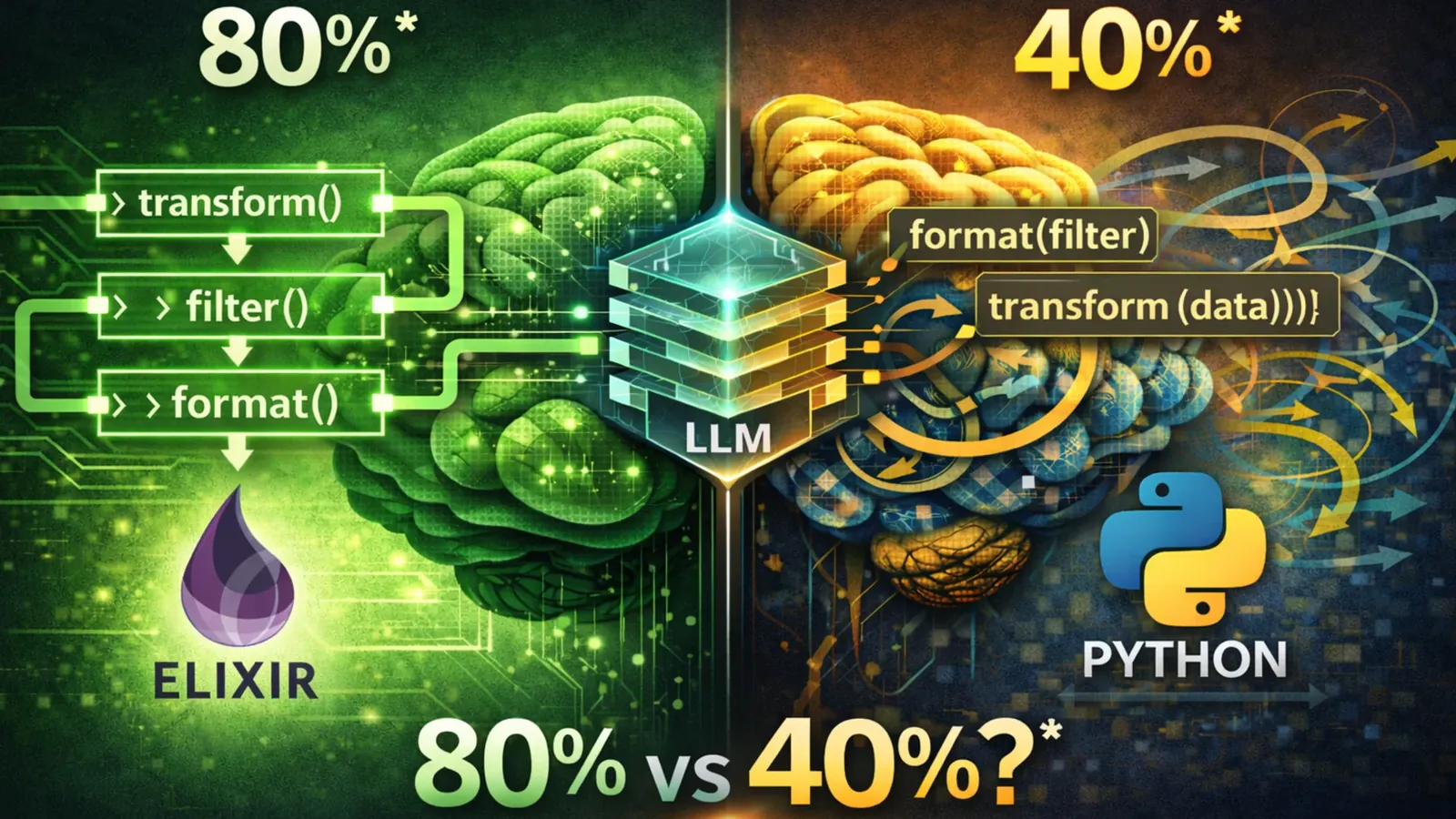
A Tencent benchmark ranked Elixir #1 for LLM code generation. As an Elixir developer, I dug into the data: the truth is more nuanced than the headline, but the structural advantages are real.
The same approach, built around different work.
Build no-code agents for research, drafts and reports. No technical background needed.
Training for marketingDecide where agents pay off, how to roll them out and how to measure the gain.
Training for leadersPrefer a fixed curriculum? Every packaged course is in the catalogue.
The ones that usually come up before a booking.
GitHub Copilot made its name with line-by-line autocomplete: it suggests the next few lines as you type. Agentic coding works differently. You describe a goal, and an agent plans the approach, reads your codebase, writes code across several files, runs the tests and iterates on errors. Claude Code works this way, and so do the agent modes now built into Copilot, Cursor and Codex. For a team, the difference is scale: an engineer stops typing every line and starts directing several pieces of work at once.
It is the goal the training is built around, not a guarantee. The gain comes from work an agent can carry end to end: well-specified features, tests, migrations, first-pass reviews and bug reproduction. A team whose backlog is full of that work gets closest; a team that mostly does research or architecture gains less. The first call is where we work out which one you are.
Far more than prompt engineering. The topics that matter now are agentic workflows with tools like Claude Code, running work in parallel with subagents, MCP integrations that connect agents to internal tools, AI-assisted code review, and finding your way round unfamiliar codebases. It should also cover how review and testing keep up once agents write more of the code. And it should run on real codebases rather than toy examples, so participants can apply it straight away.
Look for a trainer who ships production software with these tools every day, not someone who only teaches theory. Claude Code is my main development environment, for client work and for my own products such as Tymeslot, an open-source scheduling platform. So the material reflects real production workflows, real failure modes and practical workarounds, not idealised demos. Cegos Integrata, NobleProg and Code First Girls book me for exactly that.
Yes. I deliver every workshop in German (native) or English (fluent), and in bilingual teams participants can ask questions in either language. The exercises run on your team's own codebase and tools, so every one relates to the daily job. Formats include online sessions, on-site training at your offices and hybrid setups.
Something else on your mind?
Tell me about your stack and your team, and I will tell you honestly how much of your backlog agents can take on.
In English or German, on site or remote.
Trusted by teams & training providers
I deliver AI training for organisations and L&D providers.
Cegos Integrata
Commissioned trainer via a leading European L&D provider
NobleProg
AI coding workshops via one of the world's largest IT training marketplaces
Innomotics
In-house AI training for engineering teams
financial.com
In-house Cursor training for the engineering team
Digitality Agency
Training for the design team in using LLMs for coding work
Bots & People
Commissioned trainer for developer workshops
Code First Girls
Course creator: a 3-month curriculum on AI and agentic tools
Nomad Summit
Conference speaker on AI tools, agentic development and developer workflows (2025)
Vertiv
On-site workshops in AI-assisted coding for engineering teams
Deutsche Telekom
Hands-on AI coding training for enterprise engineering teams